UPDATE 9: The Denver Post has called the senate race for the Democrat, Michael Bennet over challenger Buck (R) by less than 1%. Lisa Murkowski seems destined to make history as an NPA write-in candidate in Alaska, while Washington is still evenly split between Murray (D, incumbent) and Rossi (R) at 50:50. Overall, there were 6 Senate pickups for the Republicans, with no Democratic gains. The GOP now stands at a 61 seat pickup in the House, with ten races left undecided as of this afternoon. Of those, seven of the races have the Republican candidate tied with or leading the Democratic candidate. The House indeed experienced a tsunami of epic proportions. The last time a race broke this far for the Republican party was in the 1930s.
The state legislature and governors' races were he most interesting to watch. The GOP picked up 6 governorships, while the DNC lost 7 (Rhode Island went to newly independent Lincoln Chafe). Sean Trende has the analysis of the state legislatures here. The Republicans will now control redistricting decisions in nearly every state, for the first time in many decades. 2012 will looks to be a likely Senate turnover as a result.
UPDATE 8: All data are streaming live here and here: Reid has indeed held his seat over the challenge from Angle by 5%. CO (Buck v. Bennet) and Washington (Murray v. Rossi) are too close to call. While ballots are still being counted, it appears that Lisa Murkowski will retain her seat as a a write-in candidate in Alaska - a first, and probably possible only in Alaska. The Senate remains in Democratic hands by at least two seats. The House has switched to Republican hands by a large margin. With many races still too close to call, the Republicans currently at a 59 seat pickup. A final update will be posted when some of the other races are called.
Change is coming.
UPDATE 7: California remains blue with wins by Boxer and Moon-Beam Brown (can't resist - lived there when he was Gov. the first time around).
UPDATE 6: OH is leaning red, where Kasich (R) now leads Strickland (D) for the governorship. Mick Mulvaney (R) has just defeated the Chair of the House Budget Committee, John Spratt (D) in SC. And big reversal from an update below ... Kirk (R) now leads Giannoulias (D) in IL by 2%.
UPDATE 5: Ron Johnson (R) has defeated Feingold (D) in WI, while Nikki Haley (R) has won the governorship of South Carolina over Vincent Sheeheen (D).
UPDATE 4: PA and West Virginia continue to trend purple, while Virginia and Florida are going bright-red. Reid and Angle in Nevada are too close to call (CNN reports a less than 1% separation in exit polling).
UPDATE 3: Giannoulias (D; AKA mob-banker) looks set to win Obama's old seat over Kirk (R; AKA honor-thief).
UPDATE 2: Boozman (R) has defeated Blanche Lincoln (D) in AR. Blumenthal (D) has held on in CT, as has Manchin (D) in West Virginia (part of the DNC's firewall strategy). Bill Flores (R) has just flipped the seat held by Chet Edwards in TX CD 17.
UPDATE 1: Exit polls across the board are not looking good for the DNC.
BMG is back just in time for election night 2010. Early results are below.
It looks like Florida is making a big right-ward swing. Based on early voting and polling-station interviews, it looks like the Senate will remain in GOP hands, that several important Congressional seats will move to the right (especially the 22nd district where Allen West is running to defeat Ron Klein), and that the governor's race will break for the Scott over Sink (neither of whom is particularly estimable). Rubio has already trounced Crist and Meek. Florida's Congressional District 8, currently held by the odious Alan Grayson (D), is now back in GOP hands.
Rand Paul appears to have pulled the first major Senate upset of the night in KY, while Coats (R) seems set to take the Senate seat from Ellsworth (D) in IN. Nikki Haley (R) is in a very tight race to replace Sanford (he of Appalacian Trail fame) as governor of SC.
Rob Portman (R) is now being called as holding the OH senate race for the GOP, while the OH governor's race is too close to call (Kasich v. Strickland).
Pres. Obama's old seat is in a toss-up between a mob-banker and an honor-thief; I certainly don't wish to be back in my old voting district choosing between Giannoulias (D) and Kirk (R). Christine O'Donnell (R) is now projected to have lost Biden's old seat to Coons (D).
The western states are still to early to call, although Reid appears to be doing better than anticipated from the early voting returns.
02 November 2010
27 September 2010
There's Enough Blame To Go Around
Preach it brother!
For more than a year now, voters have indeed been telling both parties to 'drop dead.' As of February of this year, more than 70% of Americans agreed with the statement, 'Washington is broken.' This is the truth that establishment Washington fears more than winning or losing an election - that Americans are rejecting it outright.
"The Tea Party movement is an expression of what I think is a mainstream widespread sentiment in America that Washington is broken, that both parties are to blame, and that people want to elect folks that are going to go to Washington, DC, number one and do what they say they’re going to do primarily stand up for the agenda that’s coming from there and offer some clear alternatives that embrace the things that make America exceptional."
For more than a year now, voters have indeed been telling both parties to 'drop dead.' As of February of this year, more than 70% of Americans agreed with the statement, 'Washington is broken.' This is the truth that establishment Washington fears more than winning or losing an election - that Americans are rejecting it outright.
21 September 2010
Breaking .. Natural Evolution
CNN is reporting that Larry Summers is leaving the President's economic team, as part of a 'natural evolution,' in the composition of that team. That leaves only Geithner from the President's original economic team, and he's been receiving quite a few mixed signals.
Maybe Boehner had an effect after all.
Maybe Boehner had an effect after all.


As If There Weren't Enough Reasons To Dump Reid
Via Politico:
Reid's campaign against Angle is rated as a toss-up right now - hopefully, he'll be tossed out in the process.
The Washington Post has this comment from the Reid campaign:'Senate Majority Leader Harry Reid had an unusual form of praise for New York's junior senator, Kirsten Gillibrand, this morning at the fundraiser Mayor Bloomberg hosted for him at his townhouse - referring to her as "the hottest member" as she sat just a few feet away, according to three sources. ... First Bloomberg spoke, then Sen. Chuck Schumer, and then Reid, according to the sources. Reid praised Schumer at length, discussing how he could have run for governor - and won - in 2006, but didn't, and instead accepted the Nevada senator's entreaties to run the DSCC. Then he turned his attention to Gillibrand, saying something about how "many senators are known for many things," according to a source. He added, "We in the Senate refer to Sen. Gillibrand as the hottest member."'
'Reid spokesman Jim Manley told Politico, "What can I say, she made The Hilll's 'Most Beautiful' list. Of course he also went on to praise her skill and tenacity and described her as an effective member of the New York delegation as well."'Well that just makes it all better doesn't it? Don't you just love Reid (he of the 'light-skinned negro' sans 'negro dialect' comments)? He's a peach. Apparently, Gillibrand will have to do without a public apology, because she's beautiful, and sexism just isn't as bad to Reid. Of course, Hispanics haven't received an apology from him either.
Reid's campaign against Angle is rated as a toss-up right now - hopefully, he'll be tossed out in the process.
14 September 2010
11 September 2010
Patriot Day 2010
We Remember Them
To Mae and David
Donald McCullough
Text: Author unknown
Published by Hinshaw Music, Inc.
Last Year's Post:
11 September 2009
Some suggested actions: sponsor a Gold Star Family, donate to TAPS, or sponsor a memorial site, or participate in a memorial.
To Mae and David
Donald McCullough
Text: Author unknown
Published by Hinshaw Music, Inc.
'In the rising of the sun and in its going down, we remember them.
In the blowing of the wind and in the chill of winter, we remember them.
In the opening of buds and in the rebirth of spring, we remember them.
In the blueness of the sky and in the warmth of summer, we remember them.
In the rustling of the leaves and in the beauty of autumn, we remember them.
In the beginning of the year and when it ends, we remember them.
When we are weary and in need of strength, we remember them.
When we are lost and sick at heart, we remember them.
When we have joys we yearn to share, we remember them.
So as long as we live they too shall live,
For they are now a part of us as we remember them.'
Last Year's Post:
11 September 2009
Call to Remembrance
We remember so many people today whose lives were set on a new course eight years ago. My friend, Todd Beamer, who was a year behind me at Wheaton College is first among them for me. He reminded us all that even in death, one can change lives and live out faith. We also remember the many who died at the Pentagon that day and subsequently, and in New York City. I remember these men and women, the members of the IL-ARNG 1544th Transportation Company, and all who have sacrificed over the last eight years.Some suggested actions: sponsor a Gold Star Family, donate to TAPS, or sponsor a memorial site, or participate in a memorial.
09 September 2010
Dreams of Anticolonialism
Dinesh D'Souza, president of King's College in New York and an Indian ex-pat, has published a fascinating little thesis on the roots of Obama's decision-making and philosophy at Forbes.com. D'Souza hypothesizes that the president's search (recounted in Dreams From My Father) for identity and purpose in his father's history, profoundly influenced Obama's current political thinking. More particularly, the senior Obama's anticolonial socialism and African economic nationalism, are at the root of Obama's rejection of American exceptionalism and his extended 'apology tour' to the rest of the world. I would add, that if D'Souza is correct, at least in part, this interpretation would explain the Obama Administration's strange rejection of many of our traditional allies, while embracing nations which, if not actively our enemies, are not our friends. D'Souza draws on his own extensive experience with the anticolonial movement that roiled India (and most 3d world countries) in the 1950s and 1960s. The whole article is worth a careful read, but some extracts are below.
'What then is Obama's dream? We don't have to speculate because the President tells us himself in his autobiography, Dreams from My Father. According to Obama, his dream is his father's dream. Notice that his title is not Dreams of My Father but rather Dreams from My Father. Obama isn't writing about his father's dreams; he is writing about the dreams he received from his father. So who was Barack Obama Sr.? He was a Luo tribesman who grew up in Kenya and studied at Harvard. He was a polygamist who had, over the course of his lifetime, four wives and eight children. One of his sons, Mark Obama, has accused him of abuse and wife-beating. He was also a regular drunk driver who got into numerous accidents, killing a man in one and causing his own legs to be amputated due to injury in another. In 1982 he got drunk at a bar in Nairobi and drove into a tree, killing himself. An odd choice, certainly, as an inspirational hero. But to his son, the elder Obama represented a great and noble cause, the cause of anticolonialism. Obama Sr. grew up during Africa's struggle to be free of European rule, and he was one of the early generation of Africans chosen to study in America and then to shape his country's future. ...
Obama Sr. was an economist, and in 1965 he published an important article in the East Africa Journal called "Problems Facing Our Socialism." Obama Sr. wasn't a doctrinaire socialist; rather, he saw state appropriation of wealth as a necessary means to achieve the anticolonial objective of taking resources away from the foreign looters and restoring them to the people of Africa. For Obama Sr. this was an issue of national autonomy. "Is it the African who owns this country? If he does, then why should he not control the economic means of growth in this country?"As he put it, "We need to eliminate power structures that have been built through excessive accumulation so that not only a few individuals shall control a vast magnitude of resources as is the case now." The senior Obama proposed that the state confiscate private land and raise taxes with no upper limit. In fact, he insisted that "theoretically there is nothing that can stop the government from taxing 100% of income so long as the people get benefits from the government commensurate with their income which is taxed." ...
It may seem incredible to suggest that the anticolonial ideology of Barack Obama Sr. is espoused by his son, the President of the United States. That is what I am saying. From a very young age and through his formative years, Obama learned to see America as a force for global domination and destruction. He came to view America's military as an instrument of neocolonial occupation. He adopted his father's position that capitalism and free markets are code words for economic plunder. Obama grew to perceive the rich as an oppressive class, a kind of neocolonial power within America. In his worldview, profits are a measure of how effectively you have ripped off the rest of society, and America's power in the world is a measure of how selfishly it consumes the globe's resources and how ruthlessly it bullies and dominates the rest of the planet. For Obama, the solutions are simple. He must work to wring the neocolonialism out of America and the West. And here is where our anticolonial understanding of Obama really takes off, because it provides a vital key to explaining not only his major policy actions but also the little details that no other theory can adequately account for.'
07 September 2010
Who's Paranoid Now?
From the increasingly rare file of excellent NY Times Op-Eds, we have this fascinating look at the political uses of charging the other guy as paranoid.
Closing thought: I wonder how many people will take this one seriously.

Remember, just because you're paranoid, doesn't mean they're not out to get you. Just ask Margaret Thatcher.'Conservatives and libertarians dubbed Lee a “liberal eco-terrorist” inspired by a “green climate of hate.” They pointed out that he traced his political “awakening” to Al Gore’s apocalyptic rhetoric. They cited an F.B.I. statement calling eco-vigilantes America’s “No. 1 domestic terrorism threat.” This was all a little ridiculous. But of course it was really an attempt to turn the tables on liberals, who have spent the last two years linking conservative rhetoric to hate crimes and antigovernment maniacs. (It’s a hard habit to break: the liberal site ThinkProgress.org quickly suggested that James Lee was actually a right-wing extremist, because his hostility to “parasitic human infants” extended to the children of illegal immigrants.). ... There’s the 32 percent of Democrats who blame “the Jews” for the financial crisis. There’s the 25 percent of African-Americans who believe the AIDS virus was created in a government lab. There’s support for state secession, which may have been higher among liberals in the Bush era than among Republicans in the age of Obama. And there’s the theory that the Bush White House knew about 9/11 in advance, which a third of Democrats endorsed as recently as 2007....But obsessing about the paranoia of the masses is often a way for American elites to gloss over their own, entirely nonsymbolic failures. In the Bush era attacking the conspiracy theories of the “angry left” made it easier for conservatives to avert their eyes from the disaster the Iraq war had become. Today, establishment liberals would much rather fret about the insanity of the Republican base than reckon with the unpopularity of Barack Obama’s domestic program.'
Closing thought: I wonder how many people will take this one seriously.

05 September 2010
Stealing From The Future
Early in 2009 the Initiative On Global Markets website published updates of then current research projects including the following description by two economists from the University of Chicago Booth School of Business.
A look at the history behind the proposal provides an interesting perspective on Mian and Sufi's final results. During the first Clinton term, Alan Blinder, an economics professor at Princeton University, proposed that the government could boost its efforts to control carbon emissions by influencing car purchases through a trade-in stimulus. His proposal at the time died a quiet death. Flash-forward to 2008, when the economy was starting its long dive, and Prof. Blinder saw his chance to ressurect his 'modest proposal,' this time emphasizing the potential economic benefits to unemployed auto workers and sales reps. In a Talk of the Nation interview one year ago, Blinder explained why he thought the program as enacted was failing:
Unlike Blinder, Mian and Sufi tested the proposal against actual sales and found that the program merely 'stole' future sales by simply advancing sales by a couple of months. Within less than a year, as the Planet Money interview with Sufi so eloquently put it, the program was a total wash. The abstract neatly sums up the paper's conclusions: 'We also find no evidence of an effect on employment, house prices, or household default rates in cities with higher exposure to the program.' In the interview, Sufi summarized the problem with assuming that government can induce behavior:
On September 1, the results of their innovative study were released. The study sought to test the Keynesian model inherent to the program by examining short and longer term impacts on consumer behavior. In short, they wanted to understand if a consumer stimulus of this kind would actually stimulate the economy, or if it would merely shift buying patterns. The Cash for Clunkers program provided the rare opportunity to test out a yet long-beloved, economic model. By comparing consumer behavior in large states with little response to the program, against consumer behavior in all states where they followed every sale made under the program, Sufi and Mian were able to run the study in real-time, as well as examine the resultant behavior in the months after Cash for Clunkers ended.Fiscal Stimulus and Macroeconomic Fluctuations: Evidence from Cash for Clunkers
Atif Mian, Associate Professor of Finance
Amir Sufi, Associate Professor of Finance
Summary: We seek to estimate the economic consequences of short‐term boost in consumer spending on cars driven by the Obama Administration’s “Cash For Clunkers” program. We exploit cross-sectional variation (across counties) in the fraction of automobiles that qualify as “clunkers” to isolate the impact of boost in auto-sales on outcomes such as unemployment, housing market, consumer defaults, and household expenditure. Our research hopes to shed light on one of the most important questions facing policy makers at a time of recession: Do Keynesian policies of government stimulus work?
A look at the history behind the proposal provides an interesting perspective on Mian and Sufi's final results. During the first Clinton term, Alan Blinder, an economics professor at Princeton University, proposed that the government could boost its efforts to control carbon emissions by influencing car purchases through a trade-in stimulus. His proposal at the time died a quiet death. Flash-forward to 2008, when the economy was starting its long dive, and Prof. Blinder saw his chance to ressurect his 'modest proposal,' this time emphasizing the potential economic benefits to unemployed auto workers and sales reps. In a Talk of the Nation interview one year ago, Blinder explained why he thought the program as enacted was failing:
Apparently Blinder thought (and presumably still does) that the car stimulus was not stimulus enough. Indeed, this is evidenced by his statement a moment later in the same interview.'Well, certainly not. Things that come through Congress never come out the way you expect them to. I mean, my proposal focused much more on, for example, emissions than on miles per gallon, although they're related, but they're not the same. And also, importantly to me, one of its objectives was to assist poor people who tend to own the clunkers. The way the law was written, you could only get the cash for the clunker if you bought a new car. And a lot of poor people can't afford to buy a new car.'
Blinder has been arguing for some time that all of the stimulus and bailout programs have been outright successes, albeit with very little evidence to back up his claims. In July of this year, he and Mark Zandi released another modest dud, "How The Great Recession Was Brought To An End." In it, the authors assert the now familiar mantra that the government's stimulus programs averted a far worse crisis, based on (you guessed it) economic modeling, and cite as evidence the rise in GDP of 3.4%. The paper was published one month before the government drastically revised its estimated growth down to 1.6%, and released the August unemployment rate, which ticked up to 9.6%. Arguably, Blinder is falling into the classic trap of failing to 'test' a model under actual conditions in order to prove its robustness and usefulness as a predictive tool.'Well, I think the stimulus part has worked swimmingly. And I should have mentioned, when I wrote that piece in July '08, I mentioned four objectives. We already talked about three: stimulus, anti-poverty and pro-environment. Right at the end, I said, And by the way, it would be good for the automobile industry. Well, that's been the objective, of course, that's been the guiding light of this legislation, this national legislation. I think it's been quite effective. I mean it's been a big stimulus to sales.'
Unlike Blinder, Mian and Sufi tested the proposal against actual sales and found that the program merely 'stole' future sales by simply advancing sales by a couple of months. Within less than a year, as the Planet Money interview with Sufi so eloquently put it, the program was a total wash. The abstract neatly sums up the paper's conclusions: 'We also find no evidence of an effect on employment, house prices, or household default rates in cities with higher exposure to the program.' In the interview, Sufi summarized the problem with assuming that government can induce behavior:
All of which is to say that while government may have a role in both boosting the economy, and in encouraging behavior, it can not do either by trying to force consumer behavior down a particular path. Doing so merely steals from the future.'We don't take a stand on whether that's a useful thing. It's hard to answer that question. You could argue that if you're in the depths of a really bad recession, maybe shifting purchases of automobiles by even a couple months, maybe that's a useful thing to do. But I think it's incredibly important for policymakers to understand whenever you induce the purchase of any good, whether it be homes, whether it be a washing machine, you are in some sense stealing those purchases from the very near future. And I think that's the key result of our paper that ends up mattering.'
27 August 2010
UPDATED: Leadership
UPDATE:
Apparently, the president figured that the best way to "do that [discuss the recent economic news]" was to give a last minute, barely audible, Rose Garden presser in which his main theme revolved around bashing the Republicans as still responsible for whatever goes wrong under his watch. Good job attempt at leading Sir!
Original Post:
We are leaderless, and that's the biggest reason for a major revolt at the polls this November (emphasis mine).
'President Obama was largely invisible to the public, taking in 10 days of R&R in the posh Chilmark section of Martha’s Vineyard. When he re-emerges to the public on Sunday, he will be kicking off a series of high profile events that have little to do with the issue foremost on Americans’ minds: jobs. On Sunday the president will travel to New Orleans to commemorate the 5th anniversary of Hurricane Katrina. On Tuesday he will deliver only his second Oval Office address, discussing the withdrawal of US combat troops from Iraq. On Wednesday and Thursday, he and his administration will focus on kick-starting peace talks between the Israelis and Palestinians.
“We know he needs to be out there to talk about the economy next week,” a White House official told ABC News. “We haven’t yet figured out the way he’s going to do that.”'
25 August 2010
UPDATED: Language Abuse
Update:
Just to hammer home the point that so many of those who claim to want civil discourse engage in anything but, we have this gem via Uppity Woman.
Original Post:
Now that we have only ten weeks until the latest 'hope and change' election, I have time to post on a niggling irritant - the abuse of language in campaigns and political discourse. The ones that bug me the most are misused on both the left and the right.
Give it a rest already people. People who are feminists are not evil dictators taking over the entire known world through murder and brute force (and the use is an insult to those that survived the real Nazis), and disagreement over whether or not marriage should be reserved or if a mosque should be built at Ground Zero does not rise to the level of phobia. And frankly, no vast conspiracies exist or could given human nature. Those who constantly yammer about the state of 'civil discourse' would do well to stop using the language they deplore (and read up a little on our historical political debates that were anything but civil). Those who want civil discourse must employ it.
Just to hammer home the point that so many of those who claim to want civil discourse engage in anything but, we have this gem via Uppity Woman.
Original Post:
Now that we have only ten weeks until the latest 'hope and change' election, I have time to post on a niggling irritant - the abuse of language in campaigns and political discourse. The ones that bug me the most are misused on both the left and the right.
Nazi:: feminazi, environazi
Phobia: homophobia, islamaphobia
Vast Conspiracies (right & left)
Give it a rest already people. People who are feminists are not evil dictators taking over the entire known world through murder and brute force (and the use is an insult to those that survived the real Nazis), and disagreement over whether or not marriage should be reserved or if a mosque should be built at Ground Zero does not rise to the level of phobia. And frankly, no vast conspiracies exist or could given human nature. Those who constantly yammer about the state of 'civil discourse' would do well to stop using the language they deplore (and read up a little on our historical political debates that were anything but civil). Those who want civil discourse must employ it.
24 August 2010
FINAL UPDATES: Primary Day in South Florida
Final Updates:
The final results put Scott up over McCollum by 3% (46:43), while McCalister indeed played the role of spoiler, taking 10%.
Update 4:
The Palm Beach Post reports that Scott's lead over McCollum has edged up by 0.7.
Update 3:
In a too-close-to-call race, Scott continues to maintain a slim lead over McCollum. At this rate, neither will be able to declare victory until early morning at the earliest
Update 2:
Mike McCalister, the third wheel in the Republican race for the Governor, is now polling in the double-digits. As was the case with myself, he may be stealing votes away from those unhappy with the candidates and tenor of the campaign. While he can't win with these numbers, he may prove to be a spoiler to McCollum and/or Scott. Dan Webster is the official Republican nominee for FL Congressional District 8 against the odious Grayson. Allen West will represent the conservative voice in District 22, having beat David Brady for the nomination.
Update 1:
Currently, Rick Scott is leading Bill McCollum in early results (46:44) while Alex Sink is handily winning her nomination. Crist, Meek (55:33 over Greene) and Rubio will face off to replace Mel Martinez as Florida's junior senator. Other Florida results may be found here. Pam Bondi is leading the Republican primary (with three contenders) to replace McCollum as the State AG, while Dan Gelber leads his opponent for the Democratic nomination.
Original Post:It's Primary Day here in Florida and ten other states, and a number of races are significant for November. To replace Sen LeMieux (the care-taker Senator who in turn replaced Mel Martinez), the Republicans are choosing between Rubio and ... Rubio. Since Crist switched to Independent, Marco Rubio has clearly sewn up his nomination, but his earlier lead over Crist appears to have moderated, who was helped by his performance during the oil spill crisis. Of longer-lasting interest has been the race for the Democratic nomination between Meeks and Greene. For a time, it looked like billionaire Greene might have a shot at taking the nomination from Meeks, but his tendency to stick his foot in his own mouth (and possibly the accompanying tendency to stick other body parts into nubile young companions with drug problems) has great depressed his polling numbers.
Florida's gubernatorial candidates are a colorful (read ethically and or morally-challenged) group on both sides. On the right, McCalister, McCollum and Scott are on the ballot, but McCalister's low-budget, low-key campaign has been utterly swamped by the increasingly nasty-attack ads traded between Scott and McCollum. McCollum and Scott have been trying to out-do (or possibly out-right) each other, particularly on immigration, while simultaneously calling each other liars. Brian Moore (whose own sight lists negative news for him) and Alex Sink are vying for the Democratic nomination, but Sink looks likely to waltz to the nomination without competition from Bud Chiles (son of former governor Lawton Chiles), who is running as an Independent. Sink's biggest issues are her relative obscurity, despite serving as the state's CFO, and her deep ties to Washington in a year where the voters hate Washington's tax-and-spend ways. The Chiles name is of course very well known in Florida, particularly South Florida where Lawton was beloved, and Bud may prove to be a spoiler for both the Democratic and the Republican nominees.
Among the more interesting Congressional races is the Florida's 22nd Congressional District, where Iraq War veteran, LTC Allen West is running again as the the Republican nomination (he last ran in 2008) against Democratic incumbent, Ron Klein. Despite running in a district that leans heavily Democratic, West has been successfully attacking Klein as hyper-partisan, and the district is now ranked as a toss-up.
Information on some of the other races and early results will be posted this evening.
15 August 2010
Remember VJ Day
Perhaps the one thing that most of the post-WWII generations 'know' about VJ Day is something they probably don't know was associated with the VJ Day celebrations - the iconic kissing sailor photo by Alfred Eisenstaedt taken during the first celebrations in New York City. Girls had posters of it on their walls when I was in college, and most of the initial links from a quick Google search of VJ Day 2010 are about the kiss, a statue of it accompanied by a national kiss-in, etc.
The celebrations that followed the Japanese surrender, and a beautifully-staged kiss were both wonderful and memorable. But Victory (Victory over Japan) Day is a solemn remembrance of the many thousands of lives poured out in the second half of a near global struggle, to block the domination of many small and weak nations by one. I find it ironic that sixty-five years after, the only mention of these events in the popular US media relates to a single staged photograph. Of course, here in the US, there is often a sense of guilt mixed in with VJ Day celebrations, tied to Japan's forced surrender following the use of a terrible weapon on her civilian population. While the reasons for forcing an unconditional surrender out of Japan are well-known, and while there will probably never be a complete consensus on the decision to use the atom bomb, it would be appropriate to celebrate the end of the war and remember the dead.
Sadly, President Obama, indeed much of the country, seems totally apathetic about such memorials. Possibly, if forced into a speech about it, the president would find it necessary to belabor American sins, arrogance and pride, without remembering why we came to such a point and what necessitated the war. There is no excuse however, for the near total silence from the media and the population. Leaders in Canada, Great Britain, even Japan (for different reasons obviously) honor August 15th with wreaths, solemnity and remembrance. We would do well not to lightly throw away our own history.
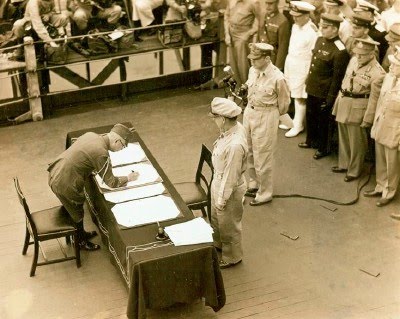
"We renew our promise to never wage war, and we promise to do our utmost to achieve eternal world peace and to never repeat again the mistake of war."
Japanese prime minister Naoto Kan
13 August 2010
Stagnation
With unemployment continuing high, retail sales bopping up and down, and the housing market and foreclosure rates still dropping, it's hard to see where the President's claim that the economy is recovering comes from. The economic picture is far from clear, and multiple indicators show some stabilization, but those felt on the individual level (consumer confidence, under- and unemployment, the state of the housing market, etc.) are still deeply mired, that recovery is seen as, at best, very modest. Fears of a either a continued jobless recovery or a double-dip recession persist.
While the solution for some on the left is to increase stimulus spending to new heights, the failure to restrain spending, particularly spending which merely prolongs failed systems and bolsters government employment, will accelerate the growth in both annual deficit and the national debt. These will in turn hamper economic growth in both the near and long-term. The Federal Reserve, CBO, and the OMB have all expressed concern recently about the dramatic rise in both indicators over the past two years, and the lack of any real plan to control them. Indeed, the OMB's Mid-Session Review revealed the government's concern that deficits will continue to accelerate while unemployment remains high. Unusually, the report was released late Friday the 29th (a news-burying tactic), and came on the heels of Peter Orzsag's announced resignation following strong disagreements with the White House over deficit-reduction.
The real dangers of rapid, long-term increases in the debt, and dramatic increases in deficit-spending, compounded with a shift from a market-driven to a government-driven economy, have been clearly seen in Greece this summer. The CBO has warned repeatedly of the growing possibility of a debt crisis, a la Greece, here in the US. These trends were of course begun under the previous administration, and have been greatly accelerated under the current one. If we fail to come to grips with our spending and borrowing habits, belt-tightening will be the first style to last for decades.
02 August 2010
The Spider and the Fly
The Obamacare organizational diagram, assembled by Congressman Kevin Brady's Office, is depicted below (click the diagram to enlarge).
 It rather reminds me of the famous grade school poem, 'The Spider and the Fly.'
Will you walk into my parlour?" said the Spider to the Fly,
'Tis the prettiest little parlour that ever you did spy;
The way into my parlour is up a winding stair,
And I've a many curious things to shew when you are there."
Oh no, no," said the little Fly, "to ask me is in vain,
For who goes up your winding stair can ne'er come down again."
"I'm sure you must be weary, dear, with soaring up so high;
Will you rest upon my little bed?" said the Spider to the Fly.
"There are pretty curtains drawn around; the sheets are fine and thin,
And if you like to rest awhile, I'll snugly tuck you in!"
Oh no, no," said the little Fly, "for I've often heard it said,
They never, never wake again, who sleep upon your bed!"
Said the cunning Spider to the Fly, " Dear friend what can I do,
To prove the warm affection I 've always felt for you?
I have within my pantry, good store of all that's nice;
I'm sure you're very welcome -- will you please to take a slice?"
"Oh no, no," said the little Fly, "kind Sir, that cannot be,
I've heard what's in your pantry, and I do not wish to see!"
"Sweet creature!" said the Spider, "you're witty and you're wise,
How handsome are your gauzy wings, how brilliant are your eyes!
I've a little looking-glass upon my parlour shelf,
If you'll step in one moment, dear, you shall behold yourself."
"I thank you, gentle sir," she said, "for what you 're pleased to say,
And bidding you good morning now, I'll call another day."
The Spider turned him round about, and went into his den,
For well he knew the silly Fly would soon come back again:
So he wove a subtle web, in a little corner sly,
And set his table ready, to dine upon the Fly.
Then he came out to his door again, and merrily did sing,
"Come hither, hither, pretty Fly, with the pearl and silver wing;
Your robes are green and purple -- there's a crest upon your head;
Your eyes are like the diamond bright, but mine are dull as lead!"
Alas, alas! how very soon this silly little Fly,
Hearing his wily, flattering words, came slowly flitting by;
With buzzing wings she hung aloft, then near and nearer drew,
Thinking only of her brilliant eyes, and green and purple hue --
Thinking only of her crested head -- poor foolish thing! At last,
Up jumped the cunning Spider, and fiercely held her fast.
He dragged her up his winding stair, into his dismal den,
Within his little parlour -- but she ne'er came out again!
And now dear little children, who may this story read,
To idle, silly flattering words, I pray you ne'er give heed:
Unto an evil counsellor, close heart and ear and eye,
And take a lesson from this tale, of the Spider and the Fly.

The Spider and the Fly
Mary Howitt
Mary Howitt
Will you walk into my parlour?" said the Spider to the Fly,
'Tis the prettiest little parlour that ever you did spy;
The way into my parlour is up a winding stair,
And I've a many curious things to shew when you are there."
Oh no, no," said the little Fly, "to ask me is in vain,
For who goes up your winding stair can ne'er come down again."
"I'm sure you must be weary, dear, with soaring up so high;
Will you rest upon my little bed?" said the Spider to the Fly.
"There are pretty curtains drawn around; the sheets are fine and thin,
And if you like to rest awhile, I'll snugly tuck you in!"
Oh no, no," said the little Fly, "for I've often heard it said,
They never, never wake again, who sleep upon your bed!"
Said the cunning Spider to the Fly, " Dear friend what can I do,
To prove the warm affection I 've always felt for you?
I have within my pantry, good store of all that's nice;
I'm sure you're very welcome -- will you please to take a slice?"
"Oh no, no," said the little Fly, "kind Sir, that cannot be,
I've heard what's in your pantry, and I do not wish to see!"
"Sweet creature!" said the Spider, "you're witty and you're wise,
How handsome are your gauzy wings, how brilliant are your eyes!
I've a little looking-glass upon my parlour shelf,
If you'll step in one moment, dear, you shall behold yourself."
"I thank you, gentle sir," she said, "for what you 're pleased to say,
And bidding you good morning now, I'll call another day."
The Spider turned him round about, and went into his den,
For well he knew the silly Fly would soon come back again:
So he wove a subtle web, in a little corner sly,
And set his table ready, to dine upon the Fly.
Then he came out to his door again, and merrily did sing,
"Come hither, hither, pretty Fly, with the pearl and silver wing;
Your robes are green and purple -- there's a crest upon your head;
Your eyes are like the diamond bright, but mine are dull as lead!"
Alas, alas! how very soon this silly little Fly,
Hearing his wily, flattering words, came slowly flitting by;
With buzzing wings she hung aloft, then near and nearer drew,
Thinking only of her brilliant eyes, and green and purple hue --
Thinking only of her crested head -- poor foolish thing! At last,
Up jumped the cunning Spider, and fiercely held her fast.
He dragged her up his winding stair, into his dismal den,
Within his little parlour -- but she ne'er came out again!
And now dear little children, who may this story read,
To idle, silly flattering words, I pray you ne'er give heed:
Unto an evil counsellor, close heart and ear and eye,
And take a lesson from this tale, of the Spider and the Fly.
A Look At the Florida Senate Race
The new Weekly Standard has an interesting look at the Florida Senate race, with emphasis on the Rubio campaign. As mentioned in the article, Rasmussen is currently the only poll showing Rubio up over Crist. All of the polls show either Crist or Rubio winning easily over either Green or Meeks.
28 July 2010
Debt and Crisis
The CBO Director's Blog has an ominous assessment of the where our massively increasing national debt may be leading us in the coming decade. While the brief is careful to note that there is no way to accurately predict when and if increasing debt will lead to financial crisis or collapse, history (and recent experiences in Greece and Poland) indicates that out-of-control debt leads to collapse.
 The full CBO report is here. Standouts from the report include the following notes:
'Unfortunately, there is no way to predict with any confidence whether and when such a crisis might occur in the United States. In a brief ("Federal Debt and the Risk of a Fiscal Crisis") released today, CBO notes that there is no identifiable “tipping point” of debt relative to the nation’s output (gross domestic product, or GDP) that would indicate that such a crisis is likely or imminent. However, in the United States, the ratio of federal debt to GDP is climbing into unfamiliar territory—and all else being equal, the higher the debt, the greater the risk of such a crisis. Over the past few years, U.S. government debt held by the public has grown rapidly. According to CBO’s projections, federal debt held by the public will stand at 62 percent of GDP at the end of fiscal year 2010, having risen from 36 percent at the end of fiscal year 2007, just before the recession began. In only one other period in U.S. history—during and shortly after World War II—has that figure exceeded 50 percent.'

In other words, continuing to add one government spending program after another, without concern for the long-term economic impacts, and without a plan for retraction, will lead to individual impacts that are worse than if the government had let the economy self-correct. Self-correction is of course not always desirable, and is frequently politically impossible, but wise leadership would apply only the remedy that is absolutely necessary, in a restrained, well-planned method, and with definitely plans for retraction.'In particular, when many workers are unemployed, and much capacity (such as equipment and buildings) is unused, higher government spending and lower tax revenues usually increase overall demand for goods and services, which leads firms to boost their output and hire more workers.4 But those short-term benefits carry with them long-term costs: Unless offsetting actions are taken at some point to pay off the additional government debt accumulated while the economy was weak, people’s future incomes will tend to be lower than they otherwise would have been.'
No matter how well-meaning policy-makers may be, the rapid growth of government involvement in the economy inevitably leads to long-term, unintended, negative consequences. Government expansion as a proscriptive against crisis may trigger the very event it seeks to avert. Finally, the report cites a lack of flexibility in responding to other crises (e.g., national security crises) as an affect of massive debt.'One impact of rising debt is that increased government borrowing tends to crowd out private investment in productive capital, because the portion of people’s savings used to buy government securities is not available to fund such investment. The result is a smaller capital stock and lower output and incomes in the long run than would otherwise be the case. The effect of debt on investment can be offset by borrowing from foreign individuals or institutions. But additional inflows of foreign capital also create the obligation for more profits and interest to flow overseas in the future. Thus, although flows of capital into a country can help maintain domestic investment, most of the gains from that additional investment do not accrue to the residents. ... Another impact of rising debt is that, as government debt grows, so does the amount of interest the government pays to its lenders (all else being equal). If policy makers wished to maintain government benefits and services while the amount of interest paid grew, tax revenues would eventually have to rise as well. To the extent that additional tax revenues were generated by increasing marginal tax rates, those rates would discourage work and saving, further reducing output and incomes. Alternatively, policymakers could choose to offset the rising interest costs, at least in part, by reductions in benefits and services.'
'A large amount of debt, however, leaves less flexibility for government actions to address financial and economic crises, which, in many countries, have been very costly to the government (as well as to residents). A large amount of debt could also harm national security by constraining military spending in times of crisis or limiting the ability to prepare for a crisis.'Finally, a little bit of historical summary:
The report on debt of course ties directly to the CBO's recent budget outlook report. The opening summary paragraphs lay out the same arguments noted above, largely from the perspective of government spending on health care, medicare/medicaid, etc.'Fiscal crises around the world have often begun during recessions and, in turn, have often exacerbated them. Frequently, such a crisis was triggered by news that a government would, for any number of reasons, need to borrow an unexpectedly large amount of money. Then, as investors lost confidence and interest rates spiked, borrowing became more difficult and expensive for the government. That development forced policymakers to immediately and substantially cut spending and increase taxes to reassure investors—or to renege on the terms of its existing debt or increase the supply of money and boost inflation. In some cases, the crisis made borrowing more expensive for private borrowers as well, because uncertainty about the government’s policy response to the crisis raised risk premiums throughout the economy. Higher private interest rates, combined with reductions in government spending and increases in taxes, have tended to worsen economic conditions in the short term.'
Daunting indeed.'Recently, the federal government has been recording the largest budget deficits, as a share of the economy, since the end of World War II. As a result of those deficits, the amount of federal debt held by the public has surged. At the end of 2008, that debt equaled 40 percent of the nation's annual economic output (as measured by gross domestic product, or GDP), a little above the 40-year average of 36 percent. Since then, large budget deficits have caused debt held by the public to shoot upward; the Congressional Budget Office (CBO) projects that federal debt will reach 62 percent of GDP by the end of this year--the highest percentage since shortly after World War II. The sharp rise in debt stems partly from lower tax revenues and higher federal spending related to the recent severe recession and turmoil in financial markets. However, the growing debt also reflects an imbalance between spending and revenues that predated those economic developments. As the economy recovers and the policies adopted to counteract the recession and the financial turmoil phase out, budget deficits will probably decline markedly in the next few years. But over the long term, the budget outlook is daunting. The retirement of the baby-boom generation portends a significant and sustained increase in the share of the population receiving benefits from Social Security, Medicare, and Medicaid. Moreover, per capita spending for health care is likely to continue rising faster than spending per person on other goods and services for many years (although the magnitude of that gap is very uncertain). Without significant changes in government policy, those factors will boost federal outlays sharply relative to GDP in coming decades under any plausible assumptions about future trends in the economy, demographics, and health care costs.'
27 July 2010
Double Dip ... Polling
President Obama's poll numbers have dipped back into negative territory (actually, they've been there for most of the prior two weeks) in a big way with today's polling numbers. The RCP average puts him at -3.3. Only the Time Magazine poll (never a bell-weather) has him in positive territory at +4, and Rasmussen has fallen to -12 (likely voter poll). Congress continues it's slow fall into the abyss at almost -50, while the Republicans are up over the Dems at +3.3. The RCP average for direction of the country is -28.7. Finally, the major toss-up elections are started to lean Republican, including major seats (e.g.: Boxer and Reid). With less than 100 days to the mid-term election, the Democrats are fast-approaching a decision-point: stick with Obama or resist to save their own skins. It's going to be an interesting Fall.
26 July 2010
When Does Sympathy Become Something More?
The saga continues surrounding the release on The Daily Caller of Journolist archives and emails, that suggested remarkable cohesiveness at the best, collusion at the worst, among the liberal bloggers, journalists and academicians that were its members. On the one end we have the argument that the Journolist members were only like-minded partisans who kicked ideas around but never followed through. This argument, epitomized by HuffPo, winds up with sentiment that '... IT'S ONLY THE FINAL PRODUCT THAT GETS REVIEWED. You're not supposed to be held responsible for the things you test behind the scenes, and then never follow through on.' This conclusion presupposes that once a central message is discussed and largely agreed upon, that message won't be promulgated. Possibly this is true, but I doubt that many members of any profession would be so restrained. Emails such as these have been used to push through settlements with companies in the past, on the presumption that they are incapable of refraining from following through on a plan for collusion once it has been thoroughly discussed. Opinions expressed at the Dallas Morning News, NewsBusters, Politics Daily, RCP, and the LA Times have all expressed deep alarm at the apparent interest by liberal news-makers and analysts in bolstering the campaign of now-President Obama while finding ways to denigrate his opponents. This is certainly not illegal, but it is also not ethical or honest. While bloggers almost never pretend to objectivity, the journalists who participated do. And citizens depend on them at least attempting to put aside their own biases and opinions to objectively report the news. In reality, few would believe that this really happens - the very selection of which stories to report expresses bias and a worldview. However, the emails already published on the Daily Caller (today's batch deals with nasty speculation about Trig Palin), clearly go beyond even the pretense of objectivity. Nor does their release rise to the level of clever editing, a la Sherrod and Brietbart, although Tucker Carson certainly runs the Daily Caller based on his own opinion and background. What they do show at best, is that many participants in media and messaging are unwilling to put aside their personal beliefs long enough to see where facts lead them. David Warren at RCP called this mind-set 'Journolism,' and attributes it to the insular, not to say incestuous, nature of most media organizations:
Here is where the real problem lies - it's impossible to tell the difference after awhile between real collusion and simple sympathy when so little distance lies between the two. Perhaps it would be better for the media to adopt the long-standing principle taught to military officers and government officials: avoid the appearance of wrong-doing as well as actual wrong.'I would say, no, they don't have to. These are all things they (er, "we") can do instinctively, without any need of formal co-ordination. All that is required is a profession whose practitioners form a self-recognizing class; who share a settled (and rather conformist) view of the world; and who spend most of their lives in each other's company, hardly ever meeting, let alone mixing socially with, people of other classes with other points of view.'
21 July 2010
Collusion
Sigh. Why I am not surprised by this.
Not much new under the sun, is there?'Excerpts published Tuesday by a conservative online news site suggest that a group of journalists from the mainstream media discussed ways to shield Barack Obama from criticism during the 2008 presidential election. Among the strategies put forward: call conservative critics racists. ... "The [JournoList] is troubling," says Jim Campbell, a political science professor at the State University of New York (SUNY) in Buffalo. "At one level it could be thought of as just colleagues throwing ideas out to one another, but from another standpoint it almost looks like collusion … where virtual talking points are shared and solidified in a group.”'
Subscribe to:
Posts (Atom)