25 August 2010

UPDATED: Language Abuse

 Update:
Just to hammer home the point that so many of those who claim to want civil discourse engage in anything but, we have this gem via Uppity Woman.


Original Post:
Now that we have only ten weeks until the latest 'hope and change' election, I have time to post on a niggling irritant - the abuse of language in campaigns and political discourse.  The ones that bug me the most are misused on both the left and the right.

Nazi::     feminazi, environazi
Vast Conspiracies (right & left)

Give it a rest already people.  People who are feminists are not evil dictators taking over the entire known world through murder and brute force (and the use is an insult to those that survived the real Nazis), and disagreement over whether or not marriage should be reserved or if a mosque should be built at Ground Zero does not rise to the level of phobia.  And frankly, no vast conspiracies exist or could given human nature.  Those who constantly yammer about the state of 'civil discourse' would do well to stop using the language they deplore (and read up a little on our historical political debates that were anything but civil).  Those who want civil discourse must employ it.

24 August 2010

FINAL UPDATES: Primary Day in South Florida

Final Updates:
The final results put Scott up over McCollum by 3% (46:43), while McCalister indeed played the role of spoiler, taking 10%.

Update 4:
The Palm Beach Post reports that Scott's lead over McCollum has edged up by 0.7.

Update 3:
In a too-close-to-call race, Scott continues to maintain a slim lead over McCollum.  At this rate, neither will be able to declare victory until early morning at the earliest

Update 2:
Mike McCalister, the third wheel in the Republican race for the Governor, is now polling in the double-digits.  As was the case with myself, he may be stealing votes away from those unhappy with the candidates and tenor of the campaign.  While he can't win with these numbers, he may prove to be a spoiler to McCollum and/or Scott.  Dan Webster is the official Republican nominee for FL Congressional District 8 against the odious Grayson.  Allen West will represent the conservative voice in District 22, having beat David Brady for the nomination.

Update 1:
Currently, Rick Scott is leading Bill McCollum in early results (46:44) while Alex Sink is handily winning her nomination.  Crist, Meek (55:33 over Greene) and Rubio will face off to replace Mel Martinez as Florida's junior senator.  Other Florida results may be found here.  Pam Bondi is leading the Republican primary (with three contenders) to replace McCollum as the State AG, while Dan Gelber leads his opponent for the Democratic nomination.

Original Post:It's Primary Day here in Florida and ten other states, and a number of races are significant for November. To replace Sen LeMieux (the care-taker Senator who in turn replaced Mel Martinez), the Republicans are choosing between Rubio and ... Rubio. Since Crist switched to Independent, Marco Rubio has clearly sewn up his nomination, but his earlier lead over Crist appears to have moderated, who was helped by his performance during the oil spill crisis.  Of longer-lasting interest has been the race for the Democratic nomination between Meeks and Greene.  For a time, it looked like billionaire Greene might have a shot at taking the nomination from Meeks, but his tendency to stick his foot in his own mouth (and possibly the accompanying tendency to stick other body parts into nubile young companions with drug problems) has great depressed his polling numbers.

Florida's gubernatorial candidates are a colorful (read ethically and or morally-challenged) group on both sides.  On the right, McCalister, McCollum and Scott are on the ballot, but McCalister's low-budget, low-key campaign has been utterly swamped by the increasingly nasty-attack ads traded between Scott and McCollum.  McCollum and Scott have been trying to out-do (or possibly out-right) each other, particularly on immigration, while simultaneously calling each other liars.  Brian Moore (whose own sight lists negative news for him) and Alex Sink are vying for the Democratic nomination, but Sink looks likely to waltz to the nomination without competition from Bud Chiles (son of former governor Lawton Chiles), who is running as an Independent.  Sink's biggest issues are her relative obscurity, despite serving as the state's CFO, and her deep ties to Washington in a year where the voters hate Washington's tax-and-spend ways.  The Chiles name is of course very well known in Florida, particularly South Florida where Lawton was beloved, and Bud may prove to be a spoiler for both the Democratic and the Republican nominees.

Among the more interesting Congressional races is the Florida's 22nd Congressional District, where Iraq War veteran, LTC Allen West is running again as the the Republican nomination (he last ran in 2008) against Democratic incumbent, Ron Klein.  Despite running in a district that leans heavily Democratic, West has been successfully attacking Klein as hyper-partisan, and the district is now ranked as a toss-up.

Information on some of the other races and early results will be posted this evening.

15 August 2010

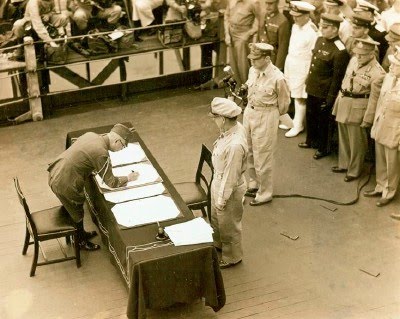
Remember VJ Day

Perhaps the one thing that most of the post-WWII generations 'know' about VJ Day is something they probably don't know was associated with the VJ Day celebrations - the iconic kissing sailor photo by Alfred Eisenstaedt taken during the first celebrations in New York City. Girls had posters of it on their walls when I was in college, and most of the initial links from a quick Google search of VJ Day 2010 are about the kiss, a statue of it accompanied by a national kiss-in, etc.

The celebrations that followed the Japanese surrender, and a beautifully-staged kiss were both wonderful and memorable. But Victory (Victory over Japan) Day is a solemn remembrance of the many thousands of lives poured out in the second half of a near global struggle, to block the domination of many small and weak nations by one. I find it ironic that sixty-five years after, the only mention of these events in the popular US media relates to a single staged photograph. Of course, here in the US, there is often a sense of guilt mixed in with VJ Day celebrations, tied to Japan's forced surrender following the use of a terrible weapon on her civilian population. While the reasons for forcing an unconditional surrender out of Japan are well-known, and while there will probably never be a complete consensus on the decision to use the atom bomb, it would be appropriate to celebrate the end of the war and remember the dead.

Sadly, President Obama, indeed much of the country, seems totally apathetic about such memorials. Possibly, if forced into a speech about it, the president would find it necessary to belabor American sins, arrogance and pride, without remembering why we came to such a point and what necessitated the war. There is no excuse however, for the near total silence from the media and the population. Leaders in Canada, Great Britain, even Japan (for different reasons obviously) honor August 15th with wreaths, solemnity and remembrance. We would do well not to lightly throw away our own history.

"We renew our promise to never wage war, and we promise to do our utmost to achieve eternal world peace and to never repeat again the mistake of war."

Japanese prime minister Naoto Kan

13 August 2010

Stagnation

With unemployment continuing high, retail sales bopping up and down, and the housing market and foreclosure rates still dropping, it's hard to see where the President's claim that the economy is recovering comes from. The economic picture is far from clear, and multiple indicators show some stabilization, but those felt on the individual level (consumer confidence, under- and unemployment, the state of the housing market, etc.) are still deeply mired, that recovery is seen as, at best, very modest. Fears of a either a continued jobless recovery or a double-dip recession persist.

While the solution for some on the left is to increase stimulus spending to new heights, the failure to restrain spending, particularly spending which merely prolongs failed systems and bolsters government employment, will accelerate the growth in both annual deficit and the national debt. These will in turn hamper economic growth in both the near and long-term. The Federal Reserve, CBO, and the OMB have all expressed concern recently about the dramatic rise in both indicators over the past two years, and the lack of any real plan to control them. Indeed, the OMB's Mid-Session Review revealed the government's concern that deficits will continue to accelerate while unemployment remains high. Unusually, the report was released late Friday the 29th (a news-burying tactic), and came on the heels of Peter Orzsag's announced resignation following strong disagreements with the White House over deficit-reduction.

The real dangers of rapid, long-term increases in the debt, and dramatic increases in deficit-spending, compounded with a shift from a market-driven to a government-driven economy, have been clearly seen in Greece this summer. The CBO has warned repeatedly of the growing possibility of a debt crisis, a la Greece, here in the US. These trends were of course begun under the previous administration, and have been greatly accelerated under the current one. If we fail to come to grips with our spending and borrowing habits, belt-tightening will be the first style to last for decades.

02 August 2010

The Spider and the Fly

The Obamacare organizational diagram, assembled by Congressman Kevin Brady's Office, is depicted below (click the diagram to enlarge).
It rather reminds me of the famous grade school poem, 'The Spider and the Fly.'
The Spider and the Fly
Mary Howitt

Will you walk into my parlour?" said the Spider to the Fly,
'Tis the prettiest little parlour that ever you did spy;
The way into my parlour is up a winding stair,
And I've a many curious things to shew when you are there."
Oh no, no," said the little Fly, "to ask me is in vain,
For who goes up your winding stair can ne'er come down again."


"I'm sure you must be weary, dear, with soaring up so high;
Will you rest upon my little bed?" said the Spider to the Fly.
"There are pretty curtains drawn around; the sheets are fine and thin,
And if you like to rest awhile, I'll snugly tuck you in!"
Oh no, no," said the little Fly, "for I've often heard it said,
They never, never wake again, who sleep upon your bed!"


Said the cunning Spider to the Fly, " Dear friend what can I do,
To prove the warm affection I 've always felt for you?
I have within my pantry, good store of all that's nice;
I'm sure you're very welcome -- will you please to take a slice?"
"Oh no, no," said the little Fly, "kind Sir, that cannot be,
I've heard what's in your pantry, and I do not wish to see!"


"Sweet creature!" said the Spider, "you're witty and you're wise,
How handsome are your gauzy wings, how brilliant are your eyes!
I've a little looking-glass upon my parlour shelf,
If you'll step in one moment, dear, you shall behold yourself."
"I thank you, gentle sir," she said, "for what you 're pleased to say,
And bidding you good morning now, I'll call another day."


The Spider turned him round about, and went into his den,
For well he knew the silly Fly would soon come back again:
So he wove a subtle web, in a little corner sly,
And set his table ready, to dine upon the Fly.
Then he came out to his door again, and merrily did sing,
"Come hither, hither, pretty Fly, with the pearl and silver wing;
Your robes are green and purple -- there's a crest upon your head;
Your eyes are like the diamond bright, but mine are dull as lead!"

Alas, alas! how very soon this silly little Fly,
Hearing his wily, flattering words, came slowly flitting by;
With buzzing wings she hung aloft, then near and nearer drew,
Thinking only of her brilliant eyes, and green and purple hue --
Thinking only of her crested head -- poor foolish thing! At last,
Up jumped the cunning Spider, and fiercely held her fast.
He dragged her up his winding stair, into his dismal den,
Within his little parlour -- but she ne'er came out again!


And now dear little children, who may this story read,
To idle, silly flattering words, I pray you ne'er give heed:
Unto an evil counsellor, close heart and ear and eye,
And take a lesson from this tale, of the Spider and the Fly.

A Look At the Florida Senate Race

The new Weekly Standard has an interesting look at the Florida Senate race, with emphasis on the Rubio campaign.  As mentioned in the article, Rasmussen is currently the only poll showing Rubio up over Crist.  All of the polls show either Crist or Rubio winning easily over either Green or Meeks.

28 July 2010

Debt and Crisis

The CBO Director's Blog has an ominous assessment of the where our massively increasing national debt may be leading us in the coming decade.  While the brief is careful to note that there is no way to accurately predict when and if increasing debt will lead to financial crisis or collapse, history (and recent experiences in Greece and Poland) indicates that out-of-control debt leads to collapse.
'Unfortunately, there is no way to predict with any confidence whether and when such a crisis might occur in the United States. In a brief ("Federal Debt and the Risk of a Fiscal Crisis") released today, CBO notes that there is no identifiable “tipping point” of debt relative to the nation’s output (gross domestic product, or GDP) that would indicate that such a crisis is likely or imminent. However, in the United States, the ratio of federal debt to GDP is climbing into unfamiliar territory—and all else being equal, the higher the debt, the greater the risk of such a crisis.  Over the past few years, U.S. government debt held by the public has grown rapidly. According to CBO’s projections, federal debt held by the public will stand at 62 percent of GDP at the end of fiscal year 2010, having risen from 36 percent at the end of fiscal year 2007, just before the recession began. In only one other period in U.S. history—during and shortly after World War II—has that figure exceeded 50 percent.'
The full CBO report is here.  Standouts from the report include the following notes:
'In particular, when many workers are unemployed, and much capacity (such as equipment and buildings) is unused, higher government spending and lower tax revenues usually increase overall demand for goods and services, which leads firms to boost their output and hire more workers.4 But those short-term benefits carry with them long-term costs: Unless offsetting actions are taken at some point to pay off the additional government debt accumulated while the economy was weak, people’s future incomes will tend to be lower than they otherwise would have been.'
In other words, continuing to add one government spending program after another, without concern for the long-term economic impacts, and without a plan for retraction, will lead to individual impacts that are worse than if the government had let the economy self-correct.  Self-correction is of course not always desirable, and is frequently politically impossible, but wise leadership would apply only the remedy that is absolutely necessary, in a restrained, well-planned method, and with definitely plans for retraction.
'One impact of rising debt is that increased government borrowing tends to crowd out private investment in productive capital, because the portion of people’s savings used to buy government securities is not available to fund such investment. The result is a smaller capital stock and lower output and incomes in the long run than would otherwise be the case. The effect of debt on investment can be offset by borrowing from foreign individuals or institutions. But additional inflows of foreign capital also create the obligation for more profits and interest to flow overseas in the future. Thus, although flows of capital into a country can help maintain domestic investment, most of the gains from that additional investment do not accrue to the residents. ... Another impact of rising debt is that, as government debt grows, so does the amount of interest the government pays to its lenders (all else being equal). If policy makers wished to maintain government benefits and services while the amount of interest paid grew, tax revenues would eventually have to rise as well. To the extent that additional tax revenues were generated by increasing marginal tax rates, those rates would discourage work and saving, further reducing output and incomes. Alternatively, policymakers could choose to offset the rising interest costs, at least in part, by reductions in benefits and services.'
No matter how well-meaning policy-makers may be, the rapid growth of government involvement in the economy inevitably leads to long-term, unintended, negative consequences. Government expansion as a proscriptive against crisis may trigger the very event it seeks to avert.  Finally, the report cites a lack of flexibility in responding to other crises (e.g., national security crises) as an affect of massive debt.
'A large amount of debt, however, leaves less flexibility for government actions to address financial and economic crises, which, in many countries, have been very costly to the government (as well as to residents). A large amount of debt could also harm national security by constraining military spending in times of crisis or limiting the ability to prepare for a crisis.'
Finally, a little bit of historical summary:
'Fiscal crises around the world have often begun during recessions and, in turn, have often exacerbated them. Frequently, such a crisis was triggered by news that a government would, for any number of reasons, need to borrow an unexpectedly large amount of money. Then, as investors lost confidence and interest rates spiked, borrowing became more difficult and expensive for the government. That development forced policymakers to immediately and substantially cut spending and increase taxes to reassure investors—or to renege on the terms of its existing debt or increase the supply of money and boost inflation. In some cases, the crisis made borrowing more expensive for private borrowers as well, because uncertainty about the government’s policy response to the crisis raised risk premiums throughout the economy. Higher private interest rates, combined with reductions in government spending and increases in taxes, have tended to worsen economic conditions in the short term.'
The report on debt of course ties directly to the CBO's recent budget outlook report. The opening summary paragraphs lay out the same arguments noted above, largely from the perspective of government spending on health care, medicare/medicaid, etc.
'Recently, the federal government has been recording the largest budget deficits, as a share of the economy, since the end of World War II. As a result of those deficits, the amount of federal debt held by the public has surged. At the end of 2008, that debt equaled 40 percent of the nation's annual economic output (as measured by gross domestic product, or GDP), a little above the 40-year average of 36 percent. Since then, large budget deficits have caused debt held by the public to shoot upward; the Congressional Budget Office (CBO) projects that federal debt will reach 62 percent of GDP by the end of this year--the highest percentage since shortly after World War II. The sharp rise in debt stems partly from lower tax revenues and higher federal spending related to the recent severe recession and turmoil in financial markets. However, the growing debt also reflects an imbalance between spending and revenues that predated those economic developments. As the economy recovers and the policies adopted to counteract the recession and the financial turmoil phase out, budget deficits will probably decline markedly in the next few years. But over the long term, the budget outlook is daunting. The retirement of the baby-boom generation portends a significant and sustained increase in the share of the population receiving benefits from Social Security, Medicare, and Medicaid. Moreover, per capita spending for health care is likely to continue rising faster than spending per person on other goods and services for many years (although the magnitude of that gap is very uncertain). Without significant changes in government policy, those factors will boost federal outlays sharply relative to GDP in coming decades under any plausible assumptions about future trends in the economy, demographics, and health care costs.'
Daunting indeed.

27 July 2010

Double Dip ... Polling

President Obama's poll numbers have dipped back into negative territory (actually, they've been there for most of the prior two weeks) in a big way with today's polling numbers.  The RCP average puts him at -3.3.  Only the Time Magazine poll (never a bell-weather) has him in positive territory at +4, and Rasmussen has fallen to -12 (likely voter poll).  Congress continues it's slow fall into the abyss at almost -50, while the Republicans are up over the Dems at +3.3.  The RCP average for direction of the country is -28.7.  Finally, the major toss-up elections are started to lean Republican, including major seats (e.g.: Boxer and Reid).  With less than 100 days to the mid-term election, the Democrats are fast-approaching a decision-point: stick with Obama or resist to save their own skins.  It's going to be an interesting Fall.

26 July 2010

When Does Sympathy Become Something More?

The saga continues surrounding the release on The Daily Caller of Journolist archives and emails, that suggested remarkable cohesiveness at the best, collusion at the worst, among the liberal bloggers, journalists and academicians that were its members.  On the one end we have the argument that the Journolist members were only like-minded partisans who kicked ideas around but never followed through.  This argument, epitomized by HuffPo, winds up with sentiment that '... IT'S ONLY THE FINAL PRODUCT THAT GETS REVIEWED. You're not supposed to be held responsible for the things you test behind the scenes, and then never follow through on.'  This conclusion presupposes that once a central message is discussed and largely agreed upon, that message won't be promulgated.  Possibly this is true, but I doubt that many members of any profession would be so restrained.  Emails such as these have been used to push through settlements with companies in the past, on the presumption that they are incapable of refraining from following through on a plan for collusion once it has been thoroughly discussed.  Opinions expressed at the Dallas Morning News, NewsBusters, Politics Daily, RCP, and the LA Times have all expressed deep alarm at the apparent interest by liberal news-makers and analysts in bolstering the campaign of now-President Obama while finding ways to denigrate his opponents.  This is certainly not illegal, but it is also not ethical or honest.  While bloggers almost never pretend to objectivity, the journalists who participated do.  And citizens depend on them at least attempting to put aside their own biases and opinions to objectively report the news.  In reality, few would believe that this really happens - the very selection of which stories to report expresses bias and a worldview.  However, the emails already published on the Daily Caller (today's batch deals with nasty speculation about Trig Palin), clearly go beyond even the pretense of objectivity.  Nor does their release rise to the level of clever editing, a la Sherrod and Brietbart, although Tucker Carson certainly runs the Daily Caller based on his own opinion and background.  What they do show at best, is that many participants in media and messaging are unwilling to put aside their personal beliefs long enough to see where facts lead them.  David Warren at RCP called this mind-set 'Journolism,' and attributes it to the insular, not to say incestuous, nature of most media organizations:
'I would say, no, they don't have to. These are all things they (er, "we") can do instinctively, without any need of formal co-ordination. All that is required is a profession whose practitioners form a self-recognizing class; who share a settled (and rather conformist) view of the world; and who spend most of their lives in each other's company, hardly ever meeting, let alone mixing socially with, people of other classes with other points of view.'
Here is where the real problem lies - it's impossible to tell the difference after awhile between real collusion and simple sympathy when so little distance lies between the two.  Perhaps it would be better for the media to adopt the long-standing principle taught to military officers and government officials: avoid the appearance of wrong-doing as well as actual wrong.

21 July 2010

Collusion

Sigh. Why I am not surprised by this.
'Excerpts published Tuesday by a conservative online news site suggest that a group of journalists from the mainstream media discussed ways to shield Barack Obama from criticism during the 2008 presidential election. Among the strategies put forward: call conservative critics racists. ... "The [JournoList] is troubling," says Jim Campbell, a political science professor at the State University of New York (SUNY) in Buffalo. "At one level it could be thought of as just colleagues throwing ideas out to one another, but from another standpoint it almost looks like collusion … where virtual talking points are shared and solidified in a group.”'
Not much new under the sun, is there?

17 July 2010

Another Quarter - Another Afghanistan Mission

Per the AP and Fox News: 'Secretary of State Hillary Clinton is heading to South Asia on a mission aimed at refining the goals of the nearly 9-year-old conflict in Afghanistan as fears mount about the war.'  We have consistently failed to establish a clearly stated mission in Afghanistan, adapting tactics to the situation as necessary, and we have yet to properly and fully source any of the stated missions to date.  Instead, we keep redefining the mission, accomplishing little in the way of long-term success as a result.  These are failures of both the Bush and Obama Administrations, and must be rectified if we are to achieve success.  This is not to advocate that we blindly stick with a mission that we're unable to accomplish, or for which there is no political and public will, but we must find a mission that we can and will support.  Otherwise, there is little point to being there.

12 July 2010

Monkey See No Evil

H/T TwiceRight:

That's right, when in doubt, deny, deny, deny. Hope and change in action folks.

08 July 2010

The Public's Latest Sobriety Treatment for the Government

Oh my, my, my.  The President's RCP average is down to -1.9, Congress is at -49.4, the GOP is up to +1.7, and the country overwhelmingly feels that the country is going in the wrong direction.  Worse for the President and Democrats, Independents are abandoning them almost across the board.  I'd like to crow, but the reality is that it's too late for crowing - the country bought into a pile of hogwash and spin in 2008, and we're going to be reaping the consequences, particularly economic consequences, for long after this Administration.  That's too serious for enjoyment.  Additionally, while many GOP candidates are performing extremely well now (e.g., Fiorina is now tied with Boxer in a dead heat), there is no overall agreement on an economic recovery plan within the GOP.  Winning in 2010 will provide a short-lived celebration without one.

In short, the public would generally agree that many politicians on all side fit this fine quote from 'MI-5' ('Spooks' in the UK): "You're just another bureaucrat with erectile dysfunction."

03 July 2010

Independence Day 2010

Unlike the political classes of today, on all sides, the Founding Fathers knew how to write with clarity, brevity and eloquence.  May God bless America.

The Unanimous Declaration of the Thirteen United States of America (July 4, 1776)
When, in the course of human events, it becomes necessary for one people to dissolve the political bands which have connected them with another, and to assume among the powers of the earth, the separate and equal station to which the laws of nature and of nature's God entitle them, a decent respect to the opinions of mankind requires that they should declare the causes which impel them to the separation.

We hold these truths to be self-evident, that all men are created equal, that they are endowed by their Creator with certain unalienable rights, that among these are life, liberty and the pursuit of happiness. That to secure these rights, governments are instituted among men, deriving their just powers from the consent of the governed. That whenever any form of government becomes destructive to these ends, it is the right of the people to alter or to abolish it, and to institute new government, laying its foundation on such principles and organizing its powers in such form, as to them shall seem most likely to effect their safety and happiness. Prudence, indeed, will dictate that governments long established should not be changed for light and transient causes; and accordingly all experience hath shown that mankind are more disposed to suffer, while evils are sufferable, than to right themselves by abolishing the forms to which they are accustomed. But when a long train of abuses and usurpations, pursuing invariably the same object evinces a design to reduce them under absolute despotism, it is their right, it is their duty, to throw off such government, and to provide new guards for their future security. --Such has been the patient sufferance of these colonies; and such is now the necessity which constrains them to alter their former systems of government. The history of the present King of Great Britain is a history of repeated injuries and usurpations, all having in direct object the establishment of an absolute tyranny over these states. To prove this, let facts be submitted to a candid world.

He has refused his assent to laws, the most wholesome and necessary for the public good.

He has forbidden his governors to pass laws of immediate and pressing importance, unless suspended in their operation till his assent should be obtained; and when so suspended, he has utterly neglected to attend to them.

He has refused to pass other laws for the accommodation of large districts of people, unless those people would relinquish the right of representation in the legislature, a right inestimable to them and formidable to tyrants only.

He has called together legislative bodies at places unusual, uncomfortable, and distant from the depository of their public records, for the sole purpose of fatiguing them into compliance with his measures.
He has dissolved representative houses repeatedly, for opposing with manly firmness his invasions on the rights of the people.

He has refused for a long time, after such dissolutions, to cause others to be elected; whereby the legislative powers, incapable of annihilation, have returned to the people at large for their exercise; the state remaining in the meantime exposed to all the dangers of invasion from without, and convulsions within.

He has endeavored to prevent the population of these states; for that purpose obstructing the laws for naturalization of foreigners; refusing to pass others to encourage their migration hither, and raising the conditions of new appropriations of lands.

He has obstructed the administration of justice, by refusing his assent to laws for establishing judiciary powers.

He has made judges dependent on his will alone, for the tenure of their offices, and the amount and payment of their salaries.

He has erected a multitude of new offices, and sent hither swarms of officers to harass our people, and eat out their substance.

He has kept among us, in times of peace, standing armies without the consent of our legislature.

He has affected to render the military independent of and superior to civil power.

He has combined with others to subject us to a jurisdiction foreign to our constitution, and unacknowledged by our laws; giving his assent to their acts of pretended legislation:

For quartering large bodies of armed troops among us:

For protecting them, by mock trial, from punishment for any murders which they should commit on the inhabitants of these states:

For cutting off our trade with all parts of the world:

For imposing taxes on us without our consent:

For depriving us in many cases, of the benefits of trial by jury:

For transporting us beyond seas to be tried for pretended offenses:

For abolishing the free system of English laws in a neighboring province, establishing therein an arbitrary government, and enlarging its boundaries so as to render it at once an example and fit instrument for introducing the same absolute rule in these colonies:

For taking away our charters, abolishing our most valuable laws, and altering fundamentally the forms of our governments:

For suspending our own legislatures, and declaring themselves invested with power to legislate for us in all cases whatsoever.

He has abdicated government here, by declaring us out of his protection and waging war against us.

He has plundered our seas, ravaged our coasts, burned our towns, and destroyed the lives of our people.

He is at this time transporting large armies of foreign mercenaries to complete the works of death, desolation and tyranny, already begun with circumstances of cruelty and perfidy scarcely paralleled in the most barbarous ages, and totally unworthy the head of a civilized nation.

He has constrained our fellow citizens taken captive on the high seas to bear arms against their country, to become the executioners of their friends and brethren, or to fall themselves by their hands.

He has excited domestic insurrections amongst us, and has endeavored to bring on the inhabitants of our frontiers, the merciless Indian savages, whose known rule of warfare, is undistinguished destruction of all ages, sexes and conditions.

In every stage of these oppressions we have petitioned for redress in the most humble terms: our repeated petitions have been answered only by repeated injury. A prince, whose character is thus marked by every act which may define a tyrant, is unfit to be the ruler of a free people.

Nor have we been wanting in attention to our British brethren. We have warned them from time to time of attempts by their legislature to extend an unwarrantable jurisdiction over us. We have reminded them of the circumstances of our emigration and settlement here. We have appealed to their native justice and magnanimity, and we have conjured them by the ties of our common kindred to disavow these usurpations, which, would inevitably interrupt our connections and correspondence. They too have been deaf to the voice of justice and of consanguinity. We must, therefore, acquiesce in the necessity, which denounces our separation, and hold them, as we hold the rest of mankind, enemies in war, in peace friends.

We, therefore, the representatives of the United States of America, in General Congress, assembled, appealing to the Supreme Judge of the world for the rectitude of our intentions, do, in the name, and by the authority of the good people of these colonies, solemnly publish and declare, that these united colonies are, and of right ought to be free and independent states; that they are absolved from all allegiance to the British Crown, and that all political connection between them and the state of Great Britain, is and ought to be totally dissolved; and that as free and independent states, they have full power to levy war, conclude peace, contract alliances, establish commerce, and to do all other acts and things which independent states may of right do. And for the support of this declaration, with a firm reliance on the protection of Divine Providence, we mutually pledge to each other our lives, our fortunes and our sacred honor.

New Hampshire: Josiah Bartlett, William Whipple, Matthew Thornton
Massachusetts: John Hancock, Samual Adams, John Adams, Robert Treat Paine, Elbridge Gerry
Rhode Island: Stephen Hopkins, William Ellery
Connecticut: Roger Sherman, Samuel Huntington, William Williams, Oliver Wolcott
New York: William Floyd, Philip Livingston, Francis Lewis, Lewis Morris
New Jersey: Richard Stockton, John Witherspoon, Francis Hopkinson, John Hart, Abraham Clark
Pennsylvania: Robert Morris, Benjamin Rush, Benjamin Franklin, John Morton, George Clymer, James Smith, George Taylor, James Wilson, George Ross
Delaware: Caesar Rodney, George Read, Thomas McKean
Maryland: Samuel Chase, William Paca, Thomas Stone, Charles Carroll of Carrollton
Virginia: George Wythe, Richard Henry Lee, Thomas Jefferson, Benjamin Harrison, Thomas Nelson, Jr., Francis Lightfoot Lee, Carter Braxton
North Carolina: William Hooper, Joseph Hewes, John Penn
South Carolina: Edward Rutledge, Thomas Heyward, Jr., Thomas Lynch, Jr., Arthur Middleton
Georgia: Button Gwinnett, Lyman Hall, George Walton

28 June 2010

The New S-A Party

Field season is done, and I'm back at it with an all-important question - are you willing to join the new 'Smart-Ass Party?' Trash-talkin' Joe seems to feel that a lot of us might be in it, just for requesting lower taxes. Remember Joe, nice is as nice does.

08 June 2010

Super Tuesday Primaries

The RCP Live Blog for results tonight is here.

Ongoing results for individual states can be found here.

Major results to date include:
South Carolina Governorship, GOP Primary- Haley leads the pack but has not yet passed 50%.
Arkansas, Senate, DNC Primary- With 2% of precincts reporting, Blanche Lincoln is leading Bill Hatler 54% to 46%
Still awaiting results from Nevada and California.  They should start trickling in by midnight EST.


06 June 2010

D Day Commemorated

Sixty-six years ago, the beaches at Normandy were the site of one of the largest invasions in history, as the Allied Forces began the slow recovery of Europe from Germany and the Axis.  Interviews with veterans from last year's celebrations, such as the one in the Telegraph with SGT Ken Scott (UK: 50th Div, Durham Light Infantry), say it all:
'"There's no hatred left, none at all," he says. "We have to move on and forget, but I felt it was my duty to come back and be reverent. There are no stains on the beach now, no bodies being washed up. The tide has cleaned this beach but it is the same beach we came up on. ... What was it like? If you were not there you will never know. Go to a cemetery and look at every cross and think of each one as a son or a husband or a father of children and count them, and then you might know a little."'
By Fox News with Jewish Veteran, Arthur Seltzer (4th Sig BN):
'Not that Arthur was alone in his endeavors. He was one of tens of thousands of young Americans who on June 6, 1944, took part in the D-Day landings, an unprecedented invasion that took so many lives, but ultimately saved the world from being crushed under the Nazi jackboot. ... Arthur did stay alive, and later on that fateful day he saw the sergeant whose idea it had been to sign the dollar bill, a dollar bill Arthur has kept to this day. "He says, 'You and I are the only two survived from that landing craft,' and I said to him. 'You mean you lost your whole squad?' and he says, "Yes I lost my whole squad." ... Arthur Seltzer's war did not end on D-Day. He went on to fight in the Battle of the Bulge, forever known as the greatest battle of the war, and on April 29, 1945, Arthur, who is Jewish, was with the American troops who discovered the Dachau concentration camp. Arthur describes the scene as, "Dead bodies all around, naked skeletons, people dressed in these uniforms with black stripes, they were half starved, the odor was so bad you could hardly take it. The odor of death."'
May we never forget.

04 June 2010

Hiring Up (or not) and Unemployment Down (sort of)

This one page article says it all:
'U.S. nonfarm payrolls expanded by a seasonally adjusted 431,000 in May, but virtually all the new jobs were temporary jobs at the U.S. Census, leaving private-sector hiring very weak in May, the Labor Department reported Friday. ... The unemployment rate fell to a seasonally adjusted 9.7% in May from 9.9% in April, according to a separate survey of 60,000 households. The decline wasn't particularly good news, however, because the drop was due to 322,000 people dropping out of the labor force.'
With fears of a double-dip recession continuing, and remaining volatility in the housing and stock markets, claims of steady economic recovery seem premature at best.

02 June 2010

Change We Can Believe In - UPDATED

UPDATE: Now that the trial of the Governor-from-Hell, Blagojevich, has begun, questions about the role of the White House and presidential associates in 'helping' to pick candidates will continue to bubble up.  Just ask Paterson and Ford about the WH cherry-picking candidates in New York.

Hannity not-withstanding, it's pretty obvious that the vague White House offer, extended by the hand of Bill Clinton, to give Joe Sestak an unpaid advisory position for dropping out of the Democratic Senate primary (against Arlen Specter), will never land the White House in real legal trouble.  The real problem is the appearance that the White House that promised to usher in change, and clear out 'politics-as-usual,' is playing the usual game.  Gibbs' utter inability to give a straight answer to any specific question was on full display during yesterday's press briefing:
'White House press secretary Robert Gibbs indicated Tuesday that Rep. Joe Sestak was not offered a spot on the President’s Intelligence Advisory Board but refused to say what was dangled in front of the Democrat in an attempt to remove him from a Senate primary. ... Sestak indicated Friday he was offered a spot on the PIAB by former President Bill Clinton, who was acting on behalf of White House Chief of Staff Rahm Emanuel.  “I heard presidential board and I think it was Intel,” Sestak said to reporters, describing his conversation with Clinton.  White House counsel Bob Bauer said Friday that Sestak was offered a spot on “a presidential or other senior executive branch advisory board.”  However, Sestak would have been ineligible for such a post. Sestak and the Obama administration both said the congressman would have kept his seat in the House if he took a spot on the PIAB. But the PIAB is comprised of individuals who are “outside the government.”'
Gibbs even seemed unable to explain why he couldn't give a specific answer on the contents of the explanatory memo issued last Friday by White House Counsel, Robert Bauer: '“Whatever’s in the memo is accurate,” Gibbs said, adding that he would “check.”'  To add to the White House's self-immolation, it appears that similar offers were made to Andrew Romanoff who is running as a Senate candidate in Colorado.  Apparently, Jim Messina (White House Deputy Chief of Staff) was dispatched to offer a White House position to Romanoff if he would agree to clear the way for Sen. Michael Bennett in the Colorado Democratic primary.  The Romanoff deal is even less sticky, legally, than the Sestak offer since Romanoff was not a declared candidate at the time.  Again, however, it appears that the more things change in D.C., the more they stay the same.  This impression is only reinforced when the parties involved and the White House refuse to specifically answer any questions about the offers on the table.

01 June 2010

"We Are Ready" (or not)

When Nancy Pelosi predicted that the Democrats would hold on to the House through 2012, there were understandable guffaws on both sides of the aisle.  Claiming that "we are ready ... and in the past when there [have] been these swings, it's been when people have not been ready," Pelosi seems to believe that readiness is enough.  I wonder what she'll make of the radical swing reflected in today's publication of Gallup's weekly polling, that gives Republicans a major jump to +6% over Democrats, the largest Republican margin ever recorded for Gallup. The enthusiasm gap between the two parties also continued to grow, indicating possible deep problems for Democrats get-out-the-vote drives.  The Gallup polling played a major role in once again flipping the RCP Generic Congressional Vote average to +0.8 for the Republicans (from +0.2 for the Democrats the day before).  Rasmussen's likely voter screen gives the Republicans a +7 average, while the Quinnipiac poll (last published May 26) give the Democrats +6.  The RCP Congressional Job Approval average is telling: -50.6, with all recent major polls giving Congress a -40 or greater.  Keep your head in the sand Nancy - it might improve your outlook.

News widget by Feedzilla


RSS news feeds and News widgets

Buzz of the Day

Apture